

On November 12, the IRS released its annual cost-of-living adjustments for retirement plans in Notice 2026-66. The headline is a $1,000 bump in the 401(k) limit. The less-reported news is that the IRA limit didn’t move at all — and for high earners over 50, a rule that quietly took effect this year gets a little stricter. Here’s the full picture, and what to do with it before the calendar turns.
401(k) Limits Go Up Again
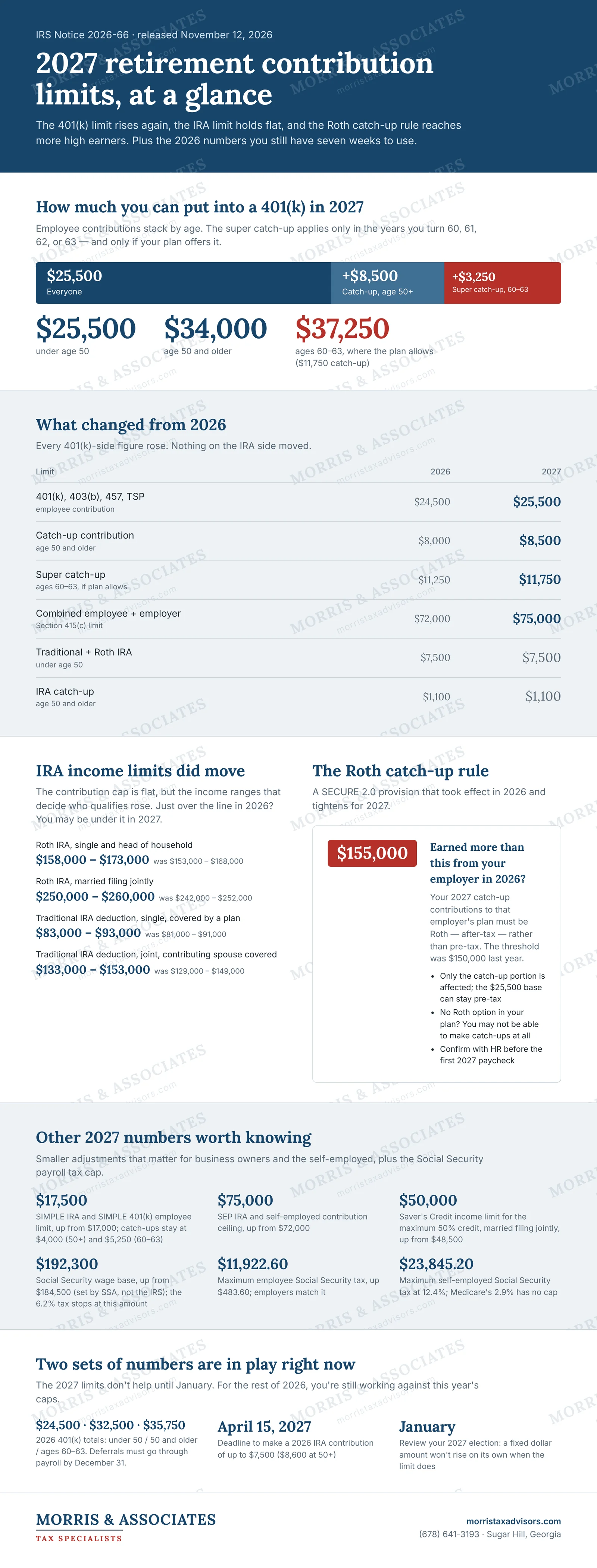
For 2027, the employee contribution limit for 401(k), 403(b), most 457 plans, and the federal Thrift Savings Plan rises to $25,500, up from $24,500 in 2026. That’s the fourth straight year of $500-to-$1,000 increases.
The catch-up contribution for workers 50 and older also rises, from $8,000 to $8,500 — bringing the total for anyone 50-plus to $34,000.
And the “super catch-up” for workers who turn 60, 61, 62, or 63 during the year, created by the SECURE 2.0 Act, increases from $11,250 to $11,750. For that four-year window, the total is $37,250 — if your employer’s plan offers it. Not all do, so it’s worth asking HR.
Here’s the full comparison:
| 2026 | 2027 | |
|---|---|---|
| 401(k) / 403(b) / 457 / TSP employee limit | $24,500 | $25,500 |
| Catch-up, age 50 and older | $8,000 | $8,500 |
| Super catch-up, ages 60–63 | $11,250 | $11,750 |
| Total limit, under 50 | $24,500 | $25,500 |
| Total limit, 50 and older | $32,500 | $34,000 |
| Total limit, ages 60–63 | $35,750 | $37,250 |
| Combined employee + employer limit (Section 415) | $72,000 | $75,000 |
That last row matters for business owners and anyone with a generous employer match: the ceiling on everything that can go into your account from all sources — your deferrals, the match, profit sharing — rises by $3,000 to $75,000.
IRA Limits Stay Flat
Here’s the part that will disappoint some savers. The IRA contribution limit stays at $7,500 for 2027, and the catch-up for those 50 and older stays at $1,100, for a combined $8,600 — identical to 2026.
Why did one limit move and the other didn’t? Both are indexed to inflation, but they round in $500 increments and use slightly different measurement periods. The 401(k) limit crossed a rounding threshold this year; the IRA limit came up just short. It will likely catch up in 2028.
What did change are the income limits that determine who can contribute to a Roth IRA or deduct a traditional IRA contribution:
- Roth IRA phase-out, single and head of household: $158,000 to $173,000 (up from $153,000 to $168,000)
- Roth IRA phase-out, married filing jointly: $250,000 to $260,000 (up from $242,000 to $252,000)
- Traditional IRA deduction phase-out, single and covered by a workplace plan: $83,000 to $93,000 (up from $81,000 to $91,000)
- Traditional IRA deduction phase-out, married filing jointly and the contributing spouse is covered: $133,000 to $153,000 (up from $129,000 to $149,000)
If you were just above the Roth income line in 2026, you may qualify in 2027 without changing anything.
The Roth Catch-Up Rule Tightens for High Earners
This is the one most people haven’t heard about. Starting with 2026, SECURE 2.0 requires that if you earned above a wage threshold in the prior year from your employer, any catch-up contribution you make to that employer’s plan must be designated Roth — after-tax — rather than pre-tax.
For 2027, that threshold rises to $155,000 of 2026 FICA wages, up from $150,000. The practical effects:
- If your 2026 W-2 wages from your employer exceed $155,000, your 2027 catch-up contribution ($8,500 or $11,750) goes in as Roth, so it won’t reduce your taxable income the way a pre-tax deferral does.
- Your regular $25,500 deferral is unaffected — it can still be pre-tax. Only the catch-up portion is subject to the rule.
- If your employer’s plan doesn’t offer a Roth option, you may not be able to make catch-up contributions at all. This is worth confirming now, before the first 2027 paycheck.
The Roth catch-up isn’t bad news — tax-free growth is valuable — but it changes the math on the deduction you were expecting, and it’s better to know about it before your withholding surprises you in January.
Other Limits Worth Noting
A few more figures that affect specific situations — from the IRS notice and from the Social Security Administration’s separate October announcement:
- SIMPLE IRA and SIMPLE 401(k): $17,500, up from $17,000; the age-50 catch-up stays at $4,000 and the ages 60–63 catch-up at $5,250
- SEP IRA / self-employed contribution ceiling: $75,000, up from $72,000
- Saver’s Credit income limit, married filing jointly: up to $50,000 for the maximum 50% credit, up from $48,500
- Social Security wage base: $192,300, up from $184,500 — set by the Social Security Administration rather than the IRS. The 6.2% Social Security tax stops at this amount, so the maximum employee share rises $483.60 to $11,922.60, matched by the employer
- Self-employed Social Security tax: 12.4% on net earnings up to $192,300, for a maximum of $23,845.20. Medicare’s 2.9% has no cap, and the 0.9% Additional Medicare Tax still applies above $200,000 single / $250,000 joint
What This Means for Year-End
Two sets of numbers are in play right now, and it’s easy to mix them up.
For the next seven weeks, you’re still working against the 2026 limits: $24,500 in your 401(k), $8,000 catch-up, $11,250 super catch-up. If you haven’t hit those and have room in your budget, raising your deferral percentage for the final pay periods is the most direct way to lower your 2026 tax bill. IRA contributions for 2026 can wait until the April 2027 filing deadline.
For January, the question is whether your contribution elections are set to take advantage of the new ceiling. Plans don’t automatically bump your contribution when the limit rises — if you contribute a fixed dollar amount, it stays where you set it. A quick review of your election before the first 2027 paycheck is worth five minutes.
And if you’re over 50 and your 2026 wages are near or above $155,000, this is the year to look at how the Roth catch-up rule affects you and whether it changes how you’d rather split your contributions.
How Morris and Associates Can Help
Retirement contributions are one of the few places where a tax decision made in November still changes the April outcome. The Morris and Associates team works with individuals and business owners to review contribution elections, model the effect of pre-tax versus Roth choices, and make sure nothing is left on the table for 2026 — while setting up 2027 correctly from the start.
If you’d like a clear picture of where you stand and what’s still worth doing before December 31, contact Morris and Associates to schedule a consultation.
Morris and Associates serves individuals and businesses throughout metro Atlanta and across Georgia. Call (678) 641-3193 or visit morristaxadvisors.com to get started.