
Every year the IRS publishes its “Dirty Dozen” list of tax scams to warn taxpayers about fraud schemes that could put their money, identity, or tax information at risk.
The list is part of a broader awareness campaign run through the Security Summit, a partnership between the IRS, state tax agencies, and the tax industry. The effort is also tied to National Slam the Scam Day, which focuses on helping taxpayers recognize identity theft and fraud attempts during tax season.
According to IRS leadership, scammers constantly adjust their tactics to take advantage of taxpayers, businesses, and even tax professionals.
Below are the 12 major scams the IRS says to watch for in 2026.
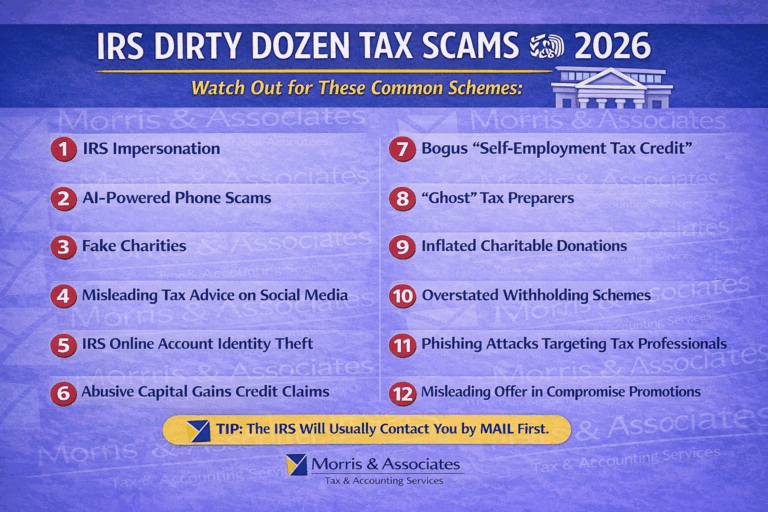
The 2026 Dirty Dozen Tax Scams
1. IRS Impersonation (Phishing and Smishing)
Scammers send emails, text messages, or social media messages pretending to be from the IRS. These messages often include urgent language or QR codes directing taxpayers to fake websites to “verify accounts” or claim refunds.
The IRS warns taxpayers never to click links in unexpected messages claiming to be from the IRS, as these may install malware or ransomware on your device.
2. AI-Powered Phone Scams
Phone scams continue to evolve using artificial intelligence, robocalls, and spoofed caller IDs to make calls appear legitimate.
Remember:
-
The IRS generally contacts taxpayers by mail first
-
The IRS does not demand immediate payment by phone
-
The IRS does not threaten arrest during phone calls
Taxpayers should always verify suspicious calls before taking action.
3. Fake Charities
Fraudsters often exploit natural disasters or tragedies by creating fake charities to collect donations.
Taxpayers should verify charities through IRS-approved nonprofit listings before donating if they want their contributions to qualify as tax deductions.
4. Misleading Tax Advice on Social Media
Social media platforms are filled with viral “tax hacks” that promise huge refunds or secret tax credits.
Many of these claims are incorrect and encourage taxpayers to submit false information, which can lead to:
-
Refund delays
-
IRS audits
-
Penalties or legal consequences
The IRS recommends relying on trusted sources such as tax professionals (such as Morris and Associates) and IRS guidance.
5. IRS Online Account Identity Theft
Criminals may attempt to access taxpayer accounts using stolen personal information or by posing as helpers offering assistance setting up IRS accounts.
Taxpayers should always create their IRS accounts directly through IRS.gov and never provide login credentials to third parties.
6. Abusive Capital Gains Credit Claims
A new scam on the list involves fraudulent claims using Form 2439, which relates to undistributed long-term capital gains.
The IRS has seen cases where scammers fabricate or inflate claims tied to fake investment funds or real estate trusts in order to generate refunds.
These improper claims may result in audits, penalties, and enforcement action.
7. Bogus “Self-Employment Tax Credit”
Some scammers promote a fake or misleading “self-employment tax credit” online.
Many taxpayers do not qualify for these credits, and the IRS is closely reviewing suspicious claims.
Taxpayers who submit inaccurate claims may face penalties.
8. “Ghost” Tax Preparers
A ghost preparer prepares a tax return but refuses to sign the return or include a Preparer Tax Identification Number (PTIN).
This is a major RED FLAG.
Taxpayers are legally responsible for what appears on their return, even if someone else prepared it.
9. Inflated Charitable Donation Schemes
Some promoters encourage taxpayers to claim exaggerated values for non-cash donations such as artwork or property.
These schemes often promise to eliminate tax liability but may involve inflated appraisals or illegal tax shelters.
10. Overstated Withholding Schemes
Some scammers encourage taxpayers to report false withholding amounts to generate larger refunds.
This can involve fraudulent wage or withholding information reported on forms such as:
-
W-2
-
1099
-
1099-OID
-
1099-NEC
-
Schedule K-1
The IRS verifies withholding with third-party records, and fraudulent claims may lead to penalties.
11. Phishing Attacks Targeting Tax Professionals
Cybercriminals often target accounting firms and tax professionals through emails pretending to be new clients or document requests.
These emails may contain malicious attachments or links designed to steal client data.
12. Misleading Offer in Compromise Promotions
The Offer in Compromise (OIC) program helps some taxpayers settle tax debt for less than the full amount owed.
However, some companies — sometimes called “OIC mills” — charge large upfront fees while promising unrealistic results to taxpayers who do not qualify.
Taxpayers should verify eligibility using official IRS tools before paying anyone for this service.
Morris and Associates can help you settle your tax debt. Whether the best solution for you is an Offer in Compromise or coming up with a payment plan, Morris and Associates will find the best, legal, and legitimate tax solution for your personal tax situation.
How to Protect Yourself from Tax Scams
The IRS recommends the following steps to protect your personal and financial information:
-
Do not click unexpected links or attachments
-
Hang up on suspicious calls claiming to be from the IRS
-
Monitor IRS accounts regularly
-
Verify charities before donating
If you believe your identity has been compromised, visit IRS.gov/idtheft for assistance.
Reporting Suspected Tax Scams
The IRS encourages taxpayers and professionals to report suspected tax fraud or abusive schemes using the online tool at IRS.gov/SubmitATip.
The system allows individuals to submit information confidentially and helps the IRS investigate fraudulent activity more quickly.
How Morris & Associates Can Help
At Morris & Associates, we help individuals and businesses protect themselves from tax scams and avoid fraudulent schemes that can lead to audits or penalties.
If you receive suspicious tax communications or are unsure about a tax credit, deduction, or offer, it’s best to speak with a trusted professional before filing.
📍 Serving Gwinnett County and the Greater Atlanta area, Morris & Associates provides reliable tax guidance and year-round support to keep your finances safe and compliant.